Management for Muscle Strains and Tendinopathy

Muscle strains and tendinopathy are fairly common in athletes and the general population. However, it can be very tricky to treat or recover from them with no proper knowledge. Use the following as a rule of thumb to help in accelerating your recovery and getting you back to what you love pain-free.

  1. Education
    • Discomfort is to be expected!!
    • Adherence is key – chronic problems require chronic treatment
  2. Load management – complete rest is contraindicated because you will get:
    • decrease muscle power/strength
    • Tendon mechanical property degradation
    • Kinetic chain movement deterioration
    • Rest will immediately decrease pain but does nothing to correct the pathology present
    • Avoid over stressing the muscle-tendon unit – don’t return to activity too quickly
  3. Exercise
  4. Pain control
    • When clinicians say “use pain as your guide” this is what they mean:
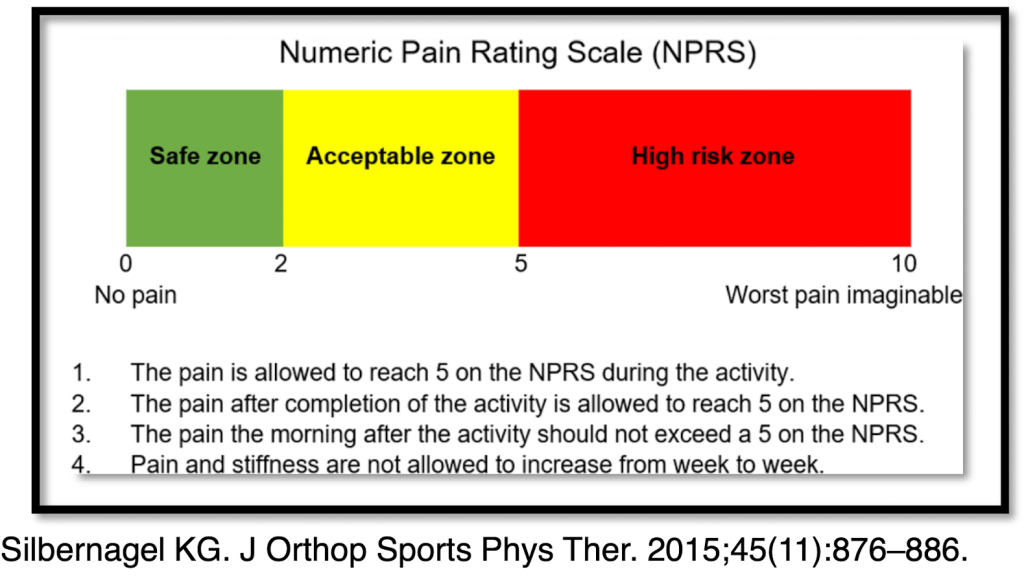
      • on a scale from 0-10, 0 being no pain and 10 is the worst pain imaginable; your safe zone is 0-2, this is where you can do activity without feeling any pain.
      • 2-5 is the acceptable zone.
        • the pain is allowed to reach 5 on the NPRS during the activity
        • The pain after completion of the activity is allowed to reach 5 on the NPRS
        • The pain the morning after the activity should not exceed a 5 on the NPRS
        • Pain and stiffness are not allowed to increase from week to week.
      • 5 -10 is the high risk zone. This zone is typically not healthy for tissue healing.

Muscle strains

  • A muscle strain is also known as a pulled muscle. It occurs when a muscle is stretched too far and part of it tears. It can be caused by overusing a muscle, using it incorrectly or an accident.
  • Think of a muscle strain as a a frayed rope
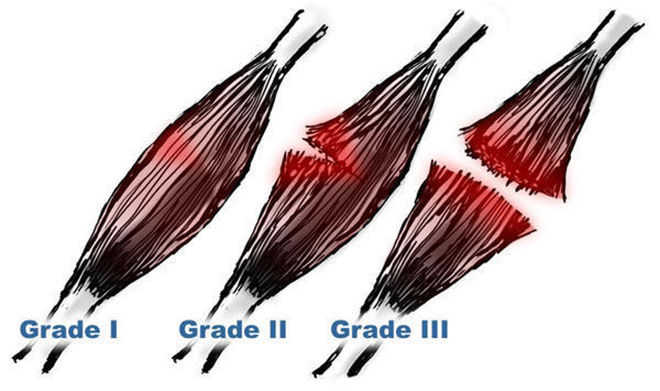
  • Grade 1 – A few muscle fibers are frayed, similar to a rope with some frayed threads. There will be minor swelling and discomfort when the muscle contracts, but the muscle can still contract with normal strength
  • Grade 2 A significant amount of muscle fibers are frayed and some are torn, similar to a rope with a lot of frayed and torn threads. This is also known as a partial tear. There is a significant loss of strength and motion in the muscle, and there may be some swelling and bruising
  • Grade 3 – the muscle is completely torn or ruptured, similar to a rope that is completely torn apart. This is also known as a complete tear. There is severe pain, swelling, and bruising, and the muscle cannot be used. This type of injury may require surgery

How to treat a Muscle strain

Interventions

  1. Stage 1 (Acute phase): The first 24-72 hrs you must pay the PRICE
    • Protect
    • Relative rest
    • Ice
    • Compression
    • Elevation
  2. Stage 2 (3 days – 2 weeks): Reduction of acute symptoms
    • Gentle range of motion (ROM) and sub-acute isometrics; modalities to reduce pain and swelling
    • Start to introduce soft tissue mobilization to reduce restrictive scare formation
  3. Stage 3 (3-4 weeks): Pain-free isometrics
    • Continue treatment as in stage 2; add strength, endurance and increase flexibility exercises
  4. Stage 4 (4-5 weeks): ROM 95% of normal, strength 75% of normal
    • Begin sport-specific activities; emphasize coordination, agility and endurance
  5. Stage 5 (6-8 weeks): Strength 95% of normal
    • Return to sport (RTS) with specific program to focus on proper warm-up, stretching and strengthening

Types of resistance Exercise: Why isometrics?

  • During an isometric the muscle contracts to produce tension without change in overall muscle-tendon length
    • no joint movement is produced
    • Muscle portion contracts, tendon portion lengthens
  • This is ideal for early stages of a strengthening program when muscle is weaker or if pain is a concern
  • It is easier to teach and learn the concept of pain-free (or low pain) contractions with isometric exercises
  • It may be tolerated better by patients with condition where shear forces may exacerbate the problem
    • I.e. Arthritis, articular cartilage lesions
  • Some recommend performance at multiple angles for better carry-over throughout the range (Brandy WD, Phys Ther, 1993)
  • Here is a comparison of isometric vs isotonic (muscle contraction with movement) in patients with patellar tendinopathy (Rio E et al, Br J Sports Med 2015)
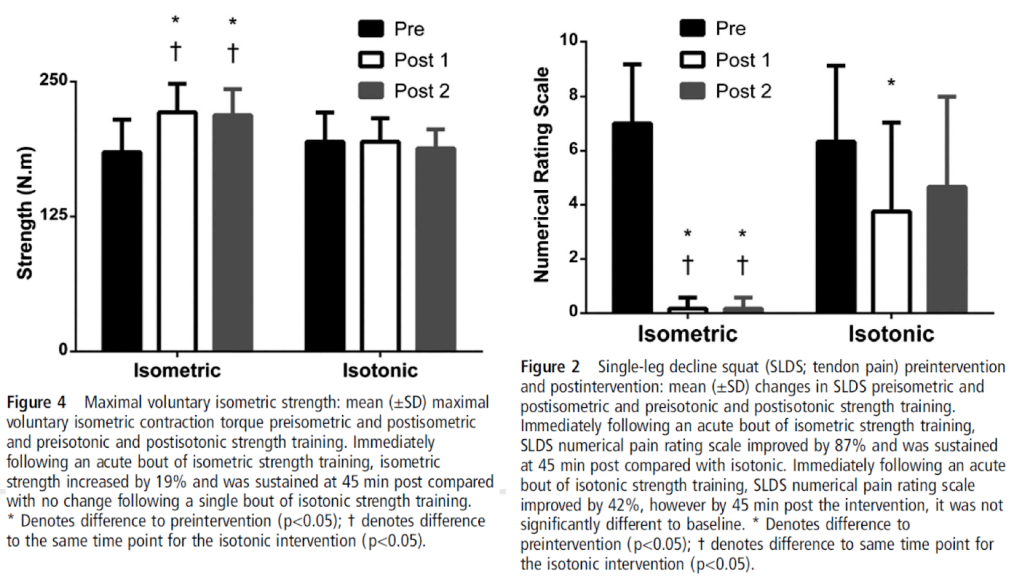
  • To be fair, this is a very small sample size (n=6). Although, in the figure on the left it demonstrates time under tension was matched between isometrics and isotonics. However, the figure on the right demonstrates pain reduction and strength increase were greater with isometric exercise than with isotonic exercise
    • immediate and 45 mins later
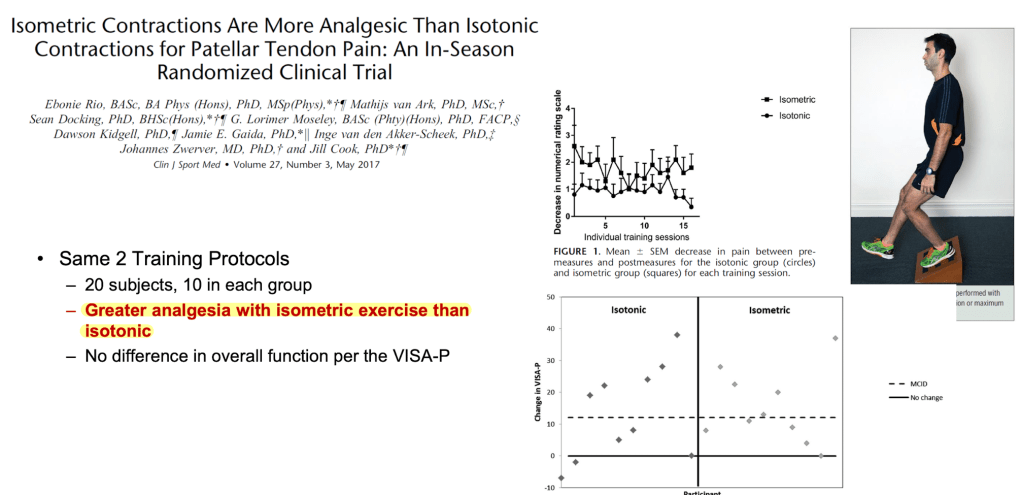
  • In the same Randomized Clinical trail, the authors tested 20 subjects, and compared between isometrics and isotonics. Results showed that greater analgesia was associated with isometric exercises over isotonics
    • Key take away: Isometrics are less painful with similar or greater strength increase.
Isometric exercise recommendations for pain-relief

  • Mid-range is ideal to avoid compression at end range
  • Hold for 30 – 45 seconds for 5 repetitions
  • 2 min-rest between contractions to allow muscle (and brain) recovery
  • Highly irritable tendons and low levels of function –> Body weight resistance
    • Perform home exercise program
    • Repeat more than once a day but consider 6 hours of rest between session
    • Progress to larger external loads as appropriate
  • Use pain to guide intensity – you don’t want to increase irritability
  • Here are a few basic exercises you can perform at home with no equipment
    • Quad sets 5 sets of 30-45 sec holds
  • Long arc quad hold at mid range 5 sets of 30-45 sec holds
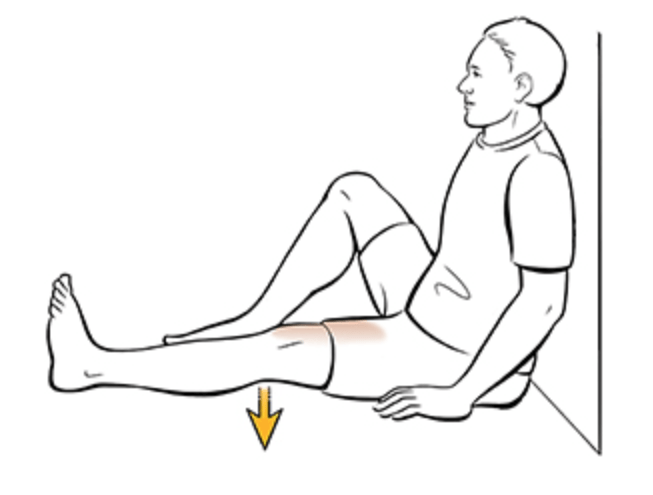
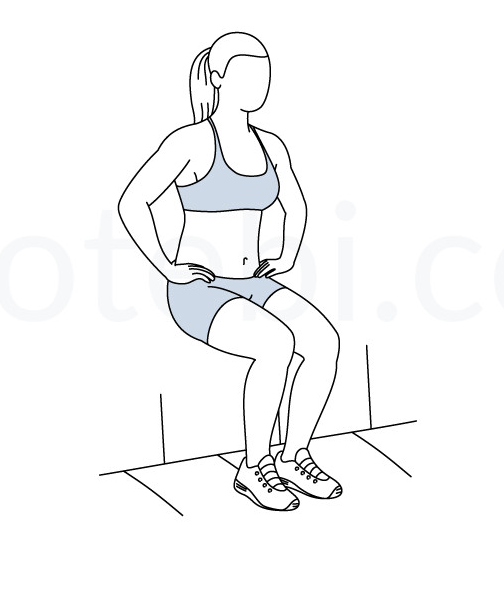
  • Wall sits at 60 degrees of knee flexion 5 sets of 30-45 sec holds
What to do after Isometric exercise?

  • Eccentric training
    • initially proposed by Alfredson for Achilles tendinopahty
      • Daily – 3 sets of 15 reps done SLOWLY
      • Can be very irritating if not progressed properly
  • Concetric training – Heavy Slow resistance
    • Aim to induce collagen synthesis and can enhance the mechanical stiffness of the tendon
    • Similar efficacy compared to eccentric exercises
      • Achilles tendinopathy
      • Patellar tendinopathy
    • 4 sets of 6-8 reps on alternate days
      • “isolated” movements when possible
      • Isometric exercise may be needed as a warm up
      • Eccentric: Concentric ration of 1:1 or greater
      • Introduce endurance later on

Graduating to Speed and Sport

Photo by Nathan Cowley on Pexels.com
  • Speed increases load on the tendon
    • begin with body weight exercise before adding external load
  • Check response to loading the next day with key test (one test repeated from baseline to finish i.e. double leg hops)
    • Increased pain with the key test may indicate too much load
  • Sport specific activities involve energy storage and release – make sure your body is ready
  • Schedule Sample:
    • Day 1 – Energy storage and sports specific activities
    • Day 2 – cross training
    • Day 3 – Heavy slow Resistance, Eccentric
    • Repeat with rest as needed

Summary

  • Muscle strains are pulled muscles, graded from 1 to 3, that occur from overloading, overstretching or an accident
  • On the NPRS grades 2 to 5 are acceptable for muscle discomfort with rehabilitation and therapeutic exercise
  • Injury recurrence is of particular concern. Structured programs with well defined clinical milestone allow a progressive, yet safe return to activity
  • Isometrics > Eccentrics > Concentric exercises
  • Late-stage revhabilaiton must include activities that achieve appropriate tissue loading thresholds that consider the speed of loading
  • Overall quality of movement should be assessed and deviations that may predispose individuals to re-injury should be addressed


Self-Analysis Questionnaire for Personal Inventory

Think and grow rich by Napoleon hill created a 28 list of questions to answer for your annual self-analysis.

Take this inventory by asking yourself the following questions and by checking your answers with the aid of someone who will not permit you to deceive yourself as to their accuracy.

  1. Have I attained the goal which I established as my objective for this year? (You should work with a definite yearly objective to be attained as a part of your major life objective.)
  2. Have I delivered service of the best possible QUALITY of which I was capable, or could I have improved any part of this service?
  3. Have I delivered service in the greatest possible QUANTITY of which I was capable?
  4. Has the spirit of my conduct been harmonious, and cooperative at all times?
  5. Have I permitted the habit of procrastination to decrease my efficiency, and if so, to what extent?
  6. Have I improved my personality and if so, in what ways?
  7. Have I been persistent in following my plans through to completion?
  8. Have I reached decisions prompts and definitely on all occasions?
  9. Have I permitted any one or more of the six basic fears to decrease my efficiency?
  10. Have I been either “over-cautious” or “under-cautious”?
  11. Has my relationship with my associates in work been pleasant, or unpleasant? If it has been unpleasant, has the fault been partly, or wholly mine?
  12. Have I dissipated any of my energy through lack of concentration of effort?
  13. Have I been open minded and tolerant in connection with all subjects?
  14. In what way have I improved my ability to render service?
  15. Have I been intemperate in any of my habits?
  16. Have I expressed, either openly or secretly, any form of egotism?
  17. Has my conduct toward my associates been such that it has induced them to Respect me?
  18. Have my opinions and decisions been based upon guess-work, or accuracy of analysis and thought?
  19. Have I followed the habit of budgeting my time, my expenses, and my income, and have I been conservative in these budgets?
  20. How much time have I devoted to unprofitable effort which I might have used to better advantage?
  21. How may I re-budget my time and change my habits so I will be more efficient during the coming year?
  22. Have I been guilty of any conduct which was not approved by my conscience?
  23. In what ways have I rendered more service and better service than I was paid to render?
  24. Have I been unfair to anyone, and if so, in what way?
  25. If I had been the purchaser of my own services for the year, would I be satisfied with my purchase?
  26. Am I in the right vocation, and if not, why not?
  27. Has the purchaser of my services been satisfied with the service I have rendered and if not, why not?
  28. What is my present rating on the fundamental principles of success?

Complete assimilation and understanding of this information here conveyed will be helpful in marketing one’s own services, and it will also help one to become more analytical and capable of judging people. The information will be priceless to personnel directors, employment managers and other executives charged with the selection of employees, and the maintenance of efficient organizations. If you doubt this statement, test its soundness by answering these questions. That might be both interesting and profitable.

The Empowered life

Place your reliance upon Allah and fulfill the 1000th principle

If you want to succeed at work, or want to succeed in your studies.

Place your reliance upon Allah and apply the 1000th principle

If you want to move out from the confines of misery to happiness and laziness to proactivity and a meaningless life to a life of meaning, value and achievement.

Place your reliance upon Allah and apply the 1000th principle

What is the 1000th principle?

There was an academic in the field of leadership studies, his name was M.R. Kopmeyer, and he authored four books on the topic of success and in each one of those books he has within it 250 principles of success.

That he’s compiled throughout his life as an expert, through coaching experience, through study, and through personal experience.

A thousand principles for success divided over four books.

He was then asked a question during an interview, “which one of these principles in your estimation is the most important?”

And he gave a very crystal clear answer…

He said, “All of the nine-hundred and ninety nine principles that I have included are absolutely useless if this one principle is not present in your life.”

It’s the principle that says “Do what you should do, when you should do it, whether your feel like it or not.”


Now, I want to share with you five principles to those who want to lead an empowered life.

Definition of empowered life – a life of proactivity, a life of vision setting, a life of meeting Allah and you’re confident to say I carried out my function as a Muslim human being in the life of Dunya.

If you feel like your life is characterized by laziness, or too much sleep, or too much socializing, or moving from one room to the other looking for something to do, or looking for something on social media to consume and you’re not really achieving what you feel like you should be achieving. Here are 5 principles that I promise you will change your life to the better.

Principles

1. Put an end to all excuses… no more justification. No more blaming your circumstance, no more blaming the streets, no more blaming social media, no more blaming your family.

Excuses are walls that weak people hide behind. It is a temporary painkiller that they take in order to mask an internal pain to convince other, and worse still to convince themselves, why they aren’t doing anything with their lives.

An excuse is shifting the blame of an internal problem onto an external circumstance.

Realize this is a slippery slope. If you find yourself always explaining away why you couldn’t do something, shouldn’t do something, wouldn’t do something, hadn’t done something then realize you are on a slippery slope of failure.

2. Your future will look like the decisions you’re making today.

What you do today, will be an illustration of who you are tomorrow.

If you’re interested in the person you’re going to be in the future looks like, I want to tell you there is no magic needed. No horoscopes, no palm reading, and no reading into the stars or a crystal ball. All you simply need to do is look into the decisions you are making today because that is what will predict the person you shall be tomorrow.

An intelligent person realizes that every unit of sacrifice, and pain and planning and going out of your comfort zone will translate into a proportional unit of happiness, and well-being and contentment and bliss in the future.

It’s a proportional exchange. And similarly the opposite is true.

Every unit of laziness, every unit of procrastination, excuses or time that is wasted will translate into a proportional unit of regret, sadness and pain.

What you do today is an accurate depiction of who you are tomorrow.

So create a vision!

3. Aim high, because the lower levels are congested with people.

Thomas Edison

The one who invented the incandescent light bulb and the first motion camera, the greatest inventor of his era.

Narrates an amazing story..

When he was still a child, he comes home one evening after school and he hands his mother over a small letter, folded in an envelope. They told him don’t open it, your mother will read it out to you.

And so Alva, mother of Thomas Edison, opens the letter and says to him, after reading the content herself and weeping.

Thomas “Mom, what does it say?” She said, the letter says

“Your son is a genius and this school doesn’t have the facility nor the talents needed to educate a boy of this caliber. So please take him out of the school and educate him yourself.”

So she took the responsibility upon herself and she gave him homeschooling and he became Thomas Edison. The genius of his century.

Then many years pass by and his mother passes away.

And on one particular day when he was rummaging through old family belongings, he opened up a desk and he found a small paper that is folded at the back of the drawer and he took it out and opened it

It said..

“Your son is mentally ill. He has no future. Take him out of the school, he is not welcome here.”

So when he read this, he understood what happened and he wept for several hours

And when he managed to gather his thoughts he pulled his diary and he wrote

“Thomas Alva Edison, was a mentally ill child but by the efforts of a hero mother became the genius of his century.”

Aim high! Because the lower levels are congested with people.

Survey says, the majority of people have not set for themselves any goals in their lives. Are you part of this statistic?

They say 80% of a population have not set for themselves any goals, its just 20% who have goals.

And of those 20% of people who have clearly identifiable goals that they are working towards, from that 20%, only 30% achieve their goals.

The issue is not that we aim high and miss. The issue is that we aim low and we hit that target. The issue is that most of us aim at nothing in life and we hit that with amazing accuracy, we receive nothing in the end!

What is your target?

Aim high because the lower levels are congested.

Thus the prophet Muhammad (PBUH) says

“إن الله تعالى يحب معالى الأمور واشرافها و يكره سفسافها”

Allah loves the high matters, the lofty matters, and Allah hates the lowly, petty matters.

Aim high because the lower levels are congested. Emerge from the deck and go to the upper deck with the people of high aspirations

When you set yourself a goal make sure it has 2 ingredients

Scholars say this is what will bring optimum performance in the life of a person and this is the Ingredient of a giant. 2 qualities are

  • #1 clearly identifiable goals
  • #2 make it ambitious – they call it a stretch goal. Something that will stretch you.

The empowered life is a success life.

Make the effort to plant the seeds today, to reap the reward of eating the fruit of your labor tomorrow.

Living With Awareness

“When we live with awareness it’s as if we’re waking from a dream. Everything looks more vivid, sounds clearer, feels richer, smells stronger and taste better. It awakens each sensation. I think pretty much everyone experiences this feeling of clarity from meditation as we cultivate this quality of mindfulness in our everyday life. Things just start to look a bit sharper. You know we start to see things with a bit more clarity. It’s not that they didn’t exist before, we just weren’t fully present to experience them through the physical senses. The body was in one place and mind was in another. We might be walking down the road but rather than being aware of all those physical senses, we were thinking about something that had happened, or planning something that might happen and that’s true sort of throughout our life. We have been caught up in this all sort of foggy mist of thinking and confusion and suddenly as we start to drop that thinking everything sort of comes into to sharper view, through every single one of our physical senses. Mostly this is a very sort of pleasant thing, but we might also experience just the noise of the business around us, and at times can even feel sort of unsettling. But if we are able to let go of the thinking about that experience and simply rest in the sensation of it, then we’ll find again a freedom and ease of mind. “

Andy Puddicome – Co-founder of headspace

Benefits of Jump Rope

Skipping rope is a versatile and low impact exercise. Unfortunately, jump rope hasn’t been a very popular tool among exercise scientists, which has resulted in very few available studies on their effectiveness. The limited number of studies, has robbed many athletes of the chance to utilize an effective tool. Despite this, any serious coach should at least consider jump rope as part of a GPP (general preparatory phase) toolkit for their athletes. Here are a number of key facts on why you should consider jumping rope.

1. Athleticism

when it comes down to it, jump rope is only a rope or cable attached to a woodchuck on each end. This simple, yet highly effective tool helps improve speed, agility, balance and coordination to any user. Once you pick up a steady rhythm, you constantly bounce on on the balls of your feet. Any that has every played any sport understand that the balls of your feet is where most of the impact, and change of direction occurs. Usain Bolt, one of the fastest men in the world said that his secret to his sprinting mechanics is staying on the balls of your feet. As you can imagine a consistent bounce on the balls of the foot by jump rope is a great translator for sports that requires constant change of direction such as basketball, soccer, boxing, sprinting and any other sport that comes to mind.

The key to jumping is being light on the balls of the foot. The more one jumps, the more proficient one becomes. The more proficient one becomes, the more the individual starts reaping the benefits. Some of the benefits include the transfer of skill to improved agility, change of direction and footwork, developing the ability to move off the balls of the feet (metatarsals) rhythmically.

Trecroci, A., Cavaggioni, L., Caccia, R., & Alberti, G. (2015). Jump Rope Training: Balance and Motor Coordination in Preadolescent Soccer Players. Journal of Sports Science & Medicine, 14(4), 792–798.

A research study published by Sport Science and Medicine Journal indicated that jump rope training effects balance and motor coordination, especially in preadolescent athletes. The study examined short, and long term effects, of training with jump rope on soccer players ages from 8 to 16 and its transfer on body balance and coordination. Over the course of 8 weeks, kids went to work with the ropes. Baseline and final measurements were evaluated though the Harre Circuit test (HCT) and Lower Quater Y balance test (YBT-LQ). These two tests evaluate participant’s motor ability and performance with different physical tasks such as the passages above or below obstacles, and unilateral dynamic lower limb balance.

Well, results showed the group that jumped rope for 10 minutes before practice had a significant reduction in time for both motor ability and performance tests. Data showed that both the experiment groups obtained a significant reduction of two
seconds, from 19.2 to 17.5 seconds in the performance time after 8 weeks of jump roping, while the CG (control group) showed a negligible reduction from 20.1 to 19.9 seconds on the Harre Circuit Test (HCT). As a result, youth soccer players should be encouraged to practice general physical activities (jump rope) together with sport specific exercises during their training sessions to improve balance and coordination.

2. Burns More Calories

Jump rope is an amazing way to get a shredded and get a lean physique. It burns a ton of calories. Research shows that jump rope is a phenomenal fat burning and muscle retaining exercise that is most commonly used by athletes such as boxers and wrestlers. They serve as great warm-up tools and can be excellent devices for breaking a sweat when cutting weight. More importantly, they can help transfer over to a number of athletic benefits to different kinds of sports. Ropes being essentially relegated to a niche sporting demographic under serves its influence onto other sports.

Compared to jogging for 30 minutes, jumping rope for 10 to 15 minutes burns the same amount, if not, more calories. According to Science Daily, “This aerobic exercise can achieve a ‘burn rate’ of up to 1300 calories per hour of vigorous activity with about 0.1 calories consumed per jump.” To put it in perspective, 10 minutes of jumping rope can roughly be the equivalent of running an eight-minute mile!”

3. Improves your Bone Density

Jump rope especially decrease injuries for the foot and ankle. When you are jumping rope, you are strengthening the muscles around your foot and ankles, making you more stable and less prone to injury. When performed properly, your skeletal system should be completely aligned and jump straight up and down.

Wolff’s law, states that bone in a healthy person or animal will adapt to the loads under which it is placed. Anything that has some impact to it or that places a load on your bones will increase their density. A study in the Journal of Applied Physiology found that young women who jumped as high as they could just 10 times, three times a week for six months, increased bone mineral density in their legs and the lower half of their spines.

4. Cardiovascular & Musculoskeletal fitness

According to research, 10 minutes of jump rope at a rate of 120 RPM provides the same cardiovascular fitness as:

  • 30 mins of jogging
  • 2 sets of tennis
  • 18 holes of golf
  • 2 miles of cycling
  • 20 mins of handball

To give you a realistic example, I saw significant changes in my body when I switched from jogging every morning for 30 mins to just 15 mins of jumping rope. I saw the results instantly and has helped me lose that stubborn belly fat I have always been trying to lose.

5. Ergogenic Health + Accessibility

We live in a world where most our work is done on a digital screen and our natural posture takes a toll from that. Oftentimes, we slouch over with our shoulders and neck looking down or forward and is not good for your lower back and discs. With good jump rope form, you are actually pulling your shoulders blades back and are opening up your chest region.

Unlike jogging or weightlifting, the accessibility of jump rope is fantastic for a wide demographic of people. Anywhere that is open with enough space for one to skip rope is good enough to get a great a sweat on. When you start increasing the intensity of your jumps, the more of those benefits transfers directly over to your sport.

6. Jump rope makes you smarter

Hard to believe but yes it does! According to the Jump Rope institute, jumping on the ball of your feet aid in the development of your left and right hemisphere of your brain. Which further enhances spatial awareness, improves reading skills, increases memory and makes you more mentally alert.

Jumping on the balls of your feet requires your body and mind to make more neural muscular adjustments to imbalances created from continuous jumping. As a result, jumping improves dynamic balance, coordination, reflexes, bone density and muscular endurance.

Summary

There are numerous of other factors to jump rope than just those mentioned above. To quickly summarize, jumping rope promotes fat loss, improves footwork and coordination, increases bone density and strengthening foot muscles, in turn, decreasing injury, and is a great source for cardiovascular fitness.

Last word of advice is to consider jumping rope into your warm up toolkit to your routine. Jump rope has enough promising attributes to make it worth considering for athletic development. Furthermore, from an investment standpoint, ropes are relatively inexpensive and versatile, and you can seamlessly plug them into multiple areas of a training program. This makes them a low-risk and potentially high-yield investment.

References

Avila, ByErick, et al. “A Case for Skipping Rope in Sports Training.” SimpliFaster, 17 Apr. 2020, simplifaster.com/articles/skipping-rope/.

Heid, Markham. “Jump Rope: The Bone Benefits of Jumping Rope.” Time, Time, 13 July 2017, time.com/4856989/jump-rope-exercise-fitness/

Hoefs, Jeremy. “Weighted Jump Rope Vs. Speed Rope.” LIVESTRONG.COM, Leaf Group, 10 July 2019, http://www.livestrong.com/article/434651-weighted-jump-rope-vs-speed-rope/.

“Jump Rope, Jump Ropes, Jumping Ropes,Rope Jumping, Skipping Rope, or Rope Shipping At Jump Rope Institute.” Jump Rope | Jump Rope For Life, 2020, http://www.jumpropeinstitute.com/.

Trecroci, A., Cavaggioni, L., Caccia, R., & Alberti, G. (2015). Jump Rope Training: Balance and Motor Coordination in Preadolescent Soccer Players. Journal of Sports Science & Medicine, 14(4), 792–798.

How to reach your goals

Here are 4 steps to manifesting your goals:

Step 1: Set a goal

  • No one can reach their highest potential unless they set goals. Write it down and have it visible.

Step 2: Start the goal

  • You can’t finish a goal unless you start one

Step 3: Take baby steps

  • If you start too big you’ll be overwhelmed. With consistency you’ll build momentum
How to overcome entrepreneurial challenges | entrepreneur snowball ...

Step 4: Look back and reward yourself for accomplishing the goal

  • Reap the reward for the hard work you’ve put in to reaching you goal(s).

Success is in the little things!

Resilience

My undergraduate college career has coming to an unexpected end but there are a number of lessons and connections that I have learned and grew from along the way. This global virus has taken us all by surprise that we could have never predicted things to turn out the way they are now. Life tests us at the most inconvenient moments alas we must face and keep moving forward. It is the collective strength and the resilience that helps us as a community to overcome these difficult times. Throughout my personal experience I have had a number of trials that have tested me beyond my perceived level. I have had a lot of peaks and valleys that helped me think outside of the norm and forced in me an adaptation response to grow and mature. Everything truly happens for a reason and staying resilient helps me not panic and control what I can control.  

The interruption of the Corona-virus crushed my vision of walking across the stage to receive my hard earned diploma and a life long plan of seeing the smile on my family’s face. This taught me the lesson to never take anything, especially the simple things, for granted as they can be taken away at any moment. Not to get too sentimental, during that time I started recognizing the true effects that comes from excelling ones physical health and mental wellness. Meanwhile, maintaining a great network of people you to surround you. Maturing and becoming grateful from not only your success but also your shortcomings is a hard pill to swallow. However, without those consequences I would have never been the man I am today. There were a lot unexpected loops that life throws at you but you must face adversity with resilience. Always look on the brighter side of things and remind yourself daily that life could definitely be worse.

This shift of focus is also known as psychological resilience . Psychologist state that all of us face trauma, adversity and other stresses that causes us to be uncomfortable. However, we can only control how we respond, not what happens. The bright spot focus, is a concept that positively impacts ones perspective to always find the good in anything. Working with the current situation or environment around you and utilizing your resources wisely helps alleviate the pain of feeling stuck or empty. I recognize that with every hard time there must come a greater good. Similar to the Chinese philosophy, the yin and the yang, illustrates in its symbol that there is a balance of good and bad in this world. That with there cannot be any good without evil and vice versa.

Yin and yang: business and IT | CIO
Yin & Yang symbol

Community resilience has been a difficult subject to perform as gatherings have very limited due to the worldwide virus. This year’s Ramadan has been quite challenging in the sense that Muslims around the world are unable to fully practice their faith by going to the mosques, visiting families and loved ones and keeping each other company. Ramadan gives us Muslims the sense of community through sharing time, food and spiritual wishes towards each other. The community helps alleviate some of the physical pain from abstaining from food and water all day (dawn to sunset) and keeps us connected with our community. Sadly, with the Covid19 being in the way, we improvised. Going to the mosque became praying at home, going over to family’s house became zooming and sharing cooking recipes and seeing old friends became sharing memes on messenger. This is another aspect of life that emphasized my growth through community resilience and practice of gratitude for what I have.

The tragedy of the corona virus infecting and killing thousands, if not millions of people worldwide.One cannot look at it any other way than sustaining all resources possible and protecting our community through these unprecedented times. The pain and difficulty that society is facing is eye opening in utilizing your expertise, at a personal scale, to your community as much as possible. The lesson I learned is that although we are all different in our own ways, in essence we are all still the same. Indra’s net is a metaphor that illustrates a network of people working together for the purpose of a greater outcome. That sense of emptiness can be eliminated by connecting and helping those around you or in other words, by applying yourself fully, to your community will change the world around for the better.

Indra's Jewel Net: a Metaphor for Interbeing
Network of Indra’s net

Learning this clicked and changed my perspective to feeling my importance in a different way. As the world does not change when you want to change, it is as important to have faith and stay patient. Growing aware of these throughout my life has brought me intellectual strengths and interests in line with my ethical beliefs that will contribute to a greater good that I am still on the path of discovering. Through my college career, I grew wiser and stronger with a better outlook towards life. The University of Delaware has brought me tremendous joy, lessons and memories that will last a lifetime. Altering my attitude is ultimately altering my perspective into believing that I represent something bigger than me. With that in mind, equipping myself with essential skills including the ability to be a lifelong learner, creator and innovator to thrive in a rapidly evolving world will be forever a lesson I am grateful to learn. 

Sustainably and Plastic Waste

According to the Intergovernmental Panel on Climate Change, humanity has until 2030 to significantly transform our energy system or else we will face catastrophic results like the increase of droughts, stronger hurricanes, and rising sea levels. These events will cost the US millions of dollars over the next few decades. As Delaware being the lowest-lying state in the country, we must take action before our state is underwater.

Climate change is a critical issue facing our world, and the university of Delaware can take its own steps to help address and mitigate the effects on our campus. I recognize that enacting change on a large scale is difficult, to say the least. Nonetheless, on the front of climate change we must do everything in our power to combat these issues as quickly as possible. This article addresses potential ways that you, the university, and the nation can help society by reducing our carbon footprint.

The popularity of single mitigation actions has been studied widely. Research shows that more than two thirds of people report to have personally taken action to mitigate climate change in Australia and New Zealand (Korkala, 2014). In the U.S., climate change mitigation actions most commonly taken include reducing energy consumption and recycling (Semanza, 2008 & 2011). In the UK, actions such as turning off lights when they are not in use and turning off tap, stopping running water while brushing teeth are popular (Whitmarsh L, 2011). On the whole, people are most willing to perform mitigation actions that are perceived as low-cost in terms of money, time and effort (Tobler 2012).

Encouraging individuals to take action is extremely important for overall success to climate change mitigation. By changing people’s perception and personal responses to climate change we could ultimately triumph. Simple alternatives in individual behavior can significantly impact global warming. We must identify actions that reduce energy consumption and waste of products. Primarily looking at a personal level, these are some key points to do to positively mitigate climate change.

What You can do to mitigate Climate Change and reduce your carbon footprint:

  1. Shop locally – Supporting small business and reduces travel
  2. Do not waste food (Eat your leftovers!) – According to one study, 40% of food is wasted daily
  3. Carpool – Reduce individual travel emissions and saves money!
  4. Shop for only what’s necessaryMinimalismA documentary about the important things
  5. Reduce, Reuse, Recycle! – Fundamental cycle of habit to do daily

Let’s look at it through the lens of our great former President, John F. Kennedy, “Ask not what your country can do for you—ask what you can do for your country.” Now, translate that idea globally! The world is the only habitual place we call home. Meanwhile, shooting a rocket to Mars and creating a new form of civilization sounds remarkable, in reality it will take us a lot years and effort to execute this idea when we can use that same energy towards our current home.

Let us not roll the dice any longer and take action towards creating a more sustainable planet. Mindfulness and integrity play a huge role in behavior towards mitigation, though every individual may struggle a bit, it is only a matter of habit change. With formation to more sustainable habits, we are able to reduce our individual carbon footprint – essentially reducing the use fossil fuels. Shifting our focus on what we can control first, then protesting against industries of major fossil fuel users is ideal. By taking these small steps to reduce our carbon footprint and use of fossil fuels, we can preserve our planet for current and future generations.

An external file that holds a picture, illustration, etc.
Object name is 11625_2017_428_Fig1_HTML.jpg
Individualistic scale of Mindfulness & Sustainability

References:

Semenza, J. C., Ploubidis, G. B., & George, L. A. (2011). Climate change and climate variability: personal motivation for adaptation and mitigation. Environmental health : a global access science source10, 46. https://doi.org/10.1186/1476-069X-10-46

Semenza JC, Hall DE, Wilson DJ, Bontempo BD, Sailor DJ, et al. (2008) Public perception of climate change voluntary mitigation and barriers to behavior change. Am J Prev Med 35: 479–487.

Whitmarsh L, Seyfang G, O’Neill S (2011) Public engagement with carbon and climate change: To what extent is the public ‘carbon capable’? Global Environ Change 21: 56–65

 Tobler C, Visschers VHM, Siegrist M (2012) Addressing climate change: Determinants of consumers’ willingness to act and to support policy measures. J Environ Psychol 32: 197–207

Community Fitness

Society nowadays has become more individualized than ever before. People go on with their lives doing the same routines, talking or not talking to the same people, go home, microwave the same food, watch the same three shows, go to bed and repeat it all over again for the next five or so years. However, research shows that sustaining this mundane lifestyle, this lack of livelihood between each other and our community, is killing our spirit.

Community fitness is a balanced set of physical, mental, emotional and social abilities used throughout communities to connect and satisfy life’s basic need to thrive. Fitness includes those abilities that promote a person’s capacity to adapt to new circumstances and to handle life’s challenges with stamina and grace. Applying fitness into a community helps our abilities of the individual members to contribute to a greater good. Collective well being, harmony with each other and with the planet is what keeps us alive and well. 

Great people like farmers, teachers and coaches contribute to the community by providing food, education and health to the people of their city with no sense of greed. Take for example the people from the short film, the Small Good Thing, a documentary that looked at five individuals in the same community that found their purpose in life by connecting with each other. Proving that one of the greatest predictors of health and happiness are peoples social ties. showing that we must walk through life with people we feel connected to and not the mundane lifestyle mentioned earlier. True community fitness are the farmers stating that they found more fulfillment in giving up their jobs to become full time farmers to give back to their community without worrying too much about income. Showing that this was a sacrifice they were willing to take for a greater cause and believing in Indra’s net.

Indra's Jewel Net: a Metaphor for Interbeing
Indra’s Net

Indra’s net is a metaphor used to illustrate the concepts of Sunyata (emptiness), Pratityasamutpada (dependent origin), and interpenetration in Buddhist philosophy. Symbolizing the universe as a web of connections and inter dependencies among all its members, wherein every member is both a manifestation of the whole and inseparable from the whole. Each jewel of Indra’s net symbolizes an individual to live out to their calling and find their purpose. “True success in life is fining your purpose and living it out.” As Shirley, the director of Youth Alive from the Small Good Thing. The fundamental idea of the Small Good Thing documentary is the idea of unity in diversity. That each individual can impact the network of community through living out their purpose.

Sadly however not everyone has that same sense of community as these people from the documentary. Society today has become more individualized than ever before. Full time jobs taking up the majority of peoples time. Limiting communication and connection between others and working just for a paycheck. This idea of individualism has become the norm for several years and some people are finally starting to realize that the average well being of our society is not dependent any longer on national income and economic growth but rather social stability.

As Richard Wilkinson describes in his ted talk, how economic inequality harms societies. He shows through studies that societies are not looking at human growth but more rather to income growth as a measure of success. Explaining the paradox through the research of life expectancy and wealth within our societies. People are looking at relative income, or one’s social position and social status and comparing those measures to one another. Stating that measuring the size of the gaps between each other is separating our community as a whole. Becoming more or less a competition rather than helping each other out. Furthermore, painting the picture of the consequences of this through the index of health and social problems of life expectancy, math and literacy, infant mortality, homicides, trust, mental illness and drug and alcohol addiction, social mobility and so much more. 

When looking at the level of trust between states in the USA, more equal states have higher trust such as Montana and Wyoming – where most people in these states can be trusted and worst amount of trust is in states like New York. With this lack of trust comes a lack of humility tying all of this into mental illness. Simply stating that mental illness stems from more unequal societies. General social dysfunction is related to inequality. It’s not one or two things that go wrong, it’s most things. The quality of life is much greater in European countries through redistribution.  

The picture above is great at illustrating the psycho-social effect on inequality, more to do with the feelings of superiority and inferiority, being valued. The more communities value status, the more fear of social evaluative judgments increases. The real message, however; is that we can improve the quality of human life by reducing judgment towards people’s incomes and see ourselves as one community. Our culture is more invested in comfort than in truth. Our planet is suffering from our consumer driven way of life. Although we have more connections through the internet and social networking, we as a society have become more isolated and lonely. We have more material wealth, but we are not individually happy.

Community Resilience during Covid-19

There has been a plethora of challenges that society has been facing as a whole since the Corona-virus outbreak. Covid -19 all happened so quickly and went from an abstraction to a very real threat. It infected people such as Tom Hanks and his wife, Dybala, an international soccer player and even the UK prime minister Boris Johnson. Once the disease became known, things just spiraled from there and everything became suspended. Closure of schools, places of worship and small (non-essential) business frightened many Americans and people around the world. This massive shut-down forced people to be laid off, furloughed and be completely out of work. Americans went in panic mode and thought the next best thing to do was to stock up on as much toilet paper as possible. Seriously though, it could be difficult to fund families and sustain a bright attitude when the unemployment rate has skyrocketed and hit all time high of 10.80 percent (and still going up). Although, this international pandemic is impacting millions of peoples of lives, communities are resilient and doing their best to help each other during these unprecedented times.

Understanding the situation the world is facing, communities are communicating not with fear but with love. Community resilience is the ability of a community to use its assets to strengthen and improve the community’s physical, behavioral, and social health to withstand, adapt and recover from adversity such as Covid-19. A resilient community is socially connected and has accessible health systems that are able to withstand disaster and foster community recovery.

Take for example, my school district alleviating the struggles of low-income students without access to meals, the district is sending out school buses throughout low-income neighborhoods and offering them free lunch. My heart melted and became so grateful for my community. Another great example that touched me was Chef José Andrés. The celebrity chef closed his D.C. area restaurants because of coronavirus but converted many into “Community Kitchens” offering lunches to people in need… How sweet and considerate. Last but absolutely not least, a Facebook page was started in my community called “I Need This!” It’s a place for community members to connect and help each other. Some people reached out because they need groceries, so there are others that go deliver what they need.

By lending a helping hand to your neighbors, focusing on what we can control as well as looking on the bright side of this chaos, builds resilience in a community. As I learned in class, Dan Heath stated to always have a bright-spot focus to situations of change. “Looking for the early glimmers that something is going right and when you find a bright spot, your mission is to study it and clone it.” Whether its our efforts to flatten out the curve, by practicing social distancing and self-quarantining, or its getting groceries to our elderly neighbors, it is all to maintain a safe and healthy community. “Despite economic concerns and high levels of stress, people have found more meaning in their lives, a closer bond with their families and communities, and a deeper connection to themselves.” Dr. Knight addressed from one of his lectures on resilience.

This shift of mindsets, looking on the good side of things, alters our psychological resilience into becoming more accepting of what we can do to adapt well to the significant sources of stress. Serious health problems, workplace and financial stress issues, as seen throughout this crisis, may lead depression and anxiety. Thus, psychological resilience teaches us to stay optimistic and to never lose hope in humanity. Because when times get tough, we are all in it as one helping each other out. That is true community resilience.

The big picture is that there are a lot of people doing good things right now. In times of uncertainty and anxiety, communities are staying resilient, helping each other get through tough times offer up what they can. Togetherness and resilience builds stronger bonds to tackle any problem we might face.