On July 13th 2018, I had the opportunity to observe a total Shoulder Arthroplasty. Here are some notes I have jotted down with continuous elaboration.
Arthroplasty is a surgical procedure to restore the function of a joint. Shoulder replacements are less common than knee or hip replacements, but it is just as successful at relieving pain. The shoulder joint is a highly sophisticated ball-and-socket joint, allowing the bones to move freely in almost all directions. The top region of the humerus has a ball shaped head that fits precisely inside a shallow socket in the shoulder blade (scapula). This socket that holds the head of the humerus is called the glenoid. The shoulder joint is composed of three bones; the clavicle, the scapula and the humerus. These three bones are connected to each other at the point where the humerus fits into the glenoid fossa of the shoulder blade is called the glenohumeral joint.
A shoulder joint replacement is commonly performed under the circumstances of arthritis or bone fractures. In order for the bones in glenohumeral joint to function pain free with no restrictions there is a smooth substance that covers the bones called Articular cartilage. This clear substance covers the ends of the bones, protecting and enabling free movement with no friction.
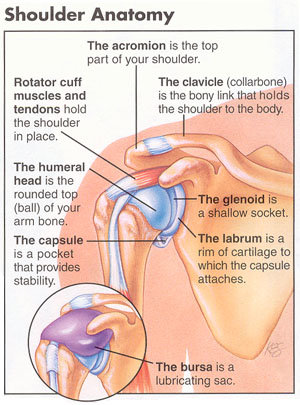
With old age the Articular Cartilage wears off, a condition referred to as “wear and tear.” That is when most people begin to feel symptoms of pain or stiffness in the upper arm. The head of the humerus experiences severe pain through the overuse of the cartilage leading to arthritis. The damaged cartilage of the glenohemural joint (Shoulder joint) decreases the space between the head of the humerus and the socket of the scapula. Causing the bones to rub against each other during motion. This condition is called Osteoarthritis, which occurs in people over 65 or with a family heritage of arthritis. As a result of the cartilage decaying, bone on bone friction takes place, causing stiffness and limited mobility.
Note the differences in space between the humerus and the scapula in the figures below. On the left is a healthy shoulder joint with normal space between the two bones. While the X-ray on the right shows little to no space in between the bones. As the cartilage that covers the ends of the bones wears away, it can result in bone rubbing on bone and produce painful bone spurs.

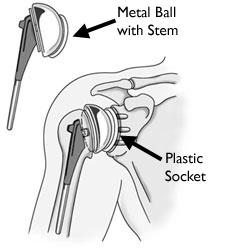
A typical shoulder joint replacement involves replacing the arthritic joint surfaces with prosthetic components. Components are a metal ball acting as the replaced head of the humerus attached to a stem. These components come in different sizes and can be cemented or “press fit “during shoulder surgery.
Surgery
The shoulder joint is vulnerable to stress, injury and arthritis. The problem occurs when the cartilage between the bones wears away and painful bone on bone occurs. Symptoms include shoulder pain, loss of motion or crepitation…noise. Surgery is recommended when non-surgical treatments fail. Total shoulder joint replacements removed all or parts of the joint to relieve pain and restore the movement.
Let’s discuss the shoulder joint replacement surgery.
To begin the patient will be seated at a reclined position. The surgeon makes an incision approximatley six inches long on the front of the shoulder. This allows the surgeon to access the joint and view the degenerated cartilage. The damaged head of the arm bone (humerus) is removed with a saw, to later replace with prosthetic implants. The bone socket is exposed after the removal of the head of the humerus. The surgeon then smooths and reshapes the bone spurs and damaged cartilage in the glenoid. Then the surgeon then proceeds by making a whole in the socket for the implant to fit in. The plastic glenoid component is pressed into place with bone cement. The surgeon hollows out the upper portion of the humerus to receive the implant. A metal stem is then implanted into thehumerus, secured with bone cement. A metal ball is attached on top of the metal stem. After all the implants are placed correctly, the surgeon then joins the repaired glenoid and humerus components to form the new shoulder joint.
This is a short yet articulate operation. This procedure only took the surgeon 40 minutes with The goal to relieve pain and restore movement in the shoulder.
References
J. Michael Wiater, MD. “Shoulder Joint Replacement – OrthoInfo – AAOS.” Clavicle Fracture (Broken Collarbone) – OrthoInfo – AAOS, Dec. 2011, orthoinfo.aaos.org/en/treatment/shoulder-joint-replacement/.
OACMorthopedics. “Total Shoulder Replacement.” YouTube, YouTube, 3 Dec. 2012, http://www.youtube.com/watch?v=3GSOo_z0vs4.
“Shoulder Replacement Surgery Video.” Arthritis-Health, http://www.arthritis-health.com/video/shoulder-replacement-surgery-video.
 Versus Co.