
Hello World,
On July 6, 2018 I had the opportunity to observe a total hip replacement done on a 66 year old patient. The patient had chronic hip pain and a disability of arthritis. The Doctor that performed the surgery was Dr. James Rubano. The operation was fairly quick, only taking him 35 minutes. I was not really able to see any parts of the incision, since the surgical incision is relatively small. Many times the only view into that surgical window is the doctor’s point of view. However, a very knowledgeable sales rep, Mike stood beside me and thoroughly explained the operation as it went. Although he was in and out of the OR very often to bring the necessary instruments to the surgeon. I was still able to get a decent amount of information down on my notepad. Nonetheless, here are my notes, thoughts and continuous elaboration of the Total Hip Replacement operation.
Anatomy
First, the anatomy! Because without the anatomy, the surgical procedures would not make any sense.
As you could imagine, a total hip replacement takes place at the hip. The hip joint is one of the largest and most important joints in the human body. It allows us to walk, run, hike, and move about freely. The hip is a ball-and-socket joint. The socket is formed by the Acetabulum. A cup-like depression in the pelvis that holds the Femoral head (the ball) in its position. The figure below is a perfect depiction.
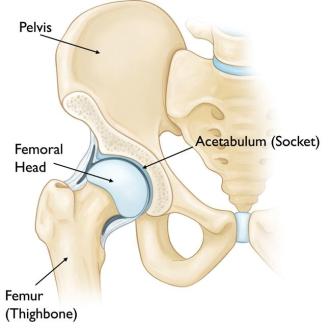
The ball-and-socket joint is a highly advanced synovial joint. Where the ball-shaped surface of one rounded bone fits into the cup-like depression of another bone. Another great example of a synovial joint is the glenohumeral joint of the shoulder. Where the rounded head of the humerus (ball) rests in a cup-like glenoid fossa (socket) of the shoulder blade. Or how I like to think of the synovial joint… a billiard pocket for the 8 ball.
The distal bone is capable of motion around an indefinite number of axes, with one common center. It enables the bone to move in nearly all directions. However, as one ages and the cartilage begins wearing and tearing the patient suffers severe pain and stiffness at the hip joint.
Causes of Hip Pain
A condition called Osteoarthritis, is an age-related “wear and tear” type of arthritis. Typically occurs in individuals 50 years or older with a family history of arthritis. Rheumatoid arthritis, is another common cause of arthritis. It is an autoimmune disease in which the synovial membrane becomes inflamed and thickened. This inflammation can damage and deteriorate the cartilage leading to pain and stiffness.
In hip osteoarthritis, the smooth articular cartilage wears away and becomes frayed and rough. Leading to severe cases of pain, stiffness and immobility. The figure below, shows the head of the femur narrowing the joint space, causing the cartilage to deteriorate and be more fragile over time.


Surgical Procedure
Now onto the good stuff! I am by no means an expert… yet. This is just MY concise explanation of the surgery.
There’s a lot of preparation that takes place before any operation. But this one looked like it took a little bit more time to fully prepare everything than the others I have observed. The patient’s vital signs are checked to make sure blood pressure, heart rate, body temperature, and oxygenation levels are normal and surgery can proceed. Once the patient is well taking care of, Anesthesia is administrated.
Once everything is set and stone, the surgeon begins by making a 10-12 inch incision on the side of the hip. Cutting through the skin, muscle and any other soft tissue to expose the bones of the hip joint. This is a traditional hip replacement surgery compared to a minimally invasive hip replacement, where the surgeon performs a much smaller incision, about 4-6 inches and cut through less soft tissue. Anyways, after the bone of the hip joint is exposed, the surgeon dislocates the joint. Cutting and removing the arthritic head of femur “ball” with a saw. Once removed, there is access to the Acetabulum, the “socket” in the pelvis. The surgeon then prepares the acetabelum for its implant using a special tool called a reamer. The reamer grinds down the acetabulum to the level of healthy bone. Then places the acetabular cup component into the reshaped socket. This cup may be porous to allow the bone to grow into it over time. Acetabular cup is a hemispheric shell inserted into pelvis. 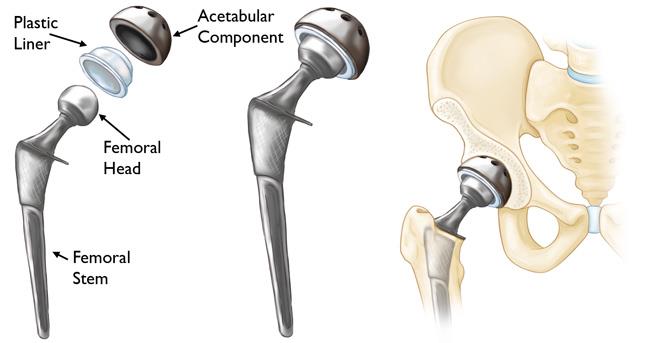
Afterwords, the surgeon moves to the femoral bone inserting a prosthetic stem into the canal of the femur. The surgeon does a series of broaches to open the femur canal wider so the femur implant can be placed comfortably. The femoral stem is a narrow, tapered metal shaft that fits several inches down inside the femur. The top of the stem is designed to hold a prosthetic ball that will replace the femoral head. A temporary prosthetic ball is attached to the top of the femoral stem. This ball is specially shaped to move with the new acetabulum cup. The surgeon then inserts the temporary ball into the new socket and move the hip around, checking to make sure the joint has ease of motion and does not dislocate. The surgeon then removes the trial components and inserts the final ball into the acetabular cup socket. Checking again for smooth and easy movement and dislocation. The surgeon will also attempt to restore optimal leg length using one of several clinical techniques.
Finally, X-rays are often taken to assure proper sizing and positioning of the components. The muscle and other soft tissues that were cut are repaired and the skin incision is stitched back together. Voilà a new hip has been placed and the just after a few weeks the patient is able to walk and hopefully experience no more pain.
References
DePuyVideos. “The Latest Procedure: Anterior Approach Total Hip Replacement Surgery.” YouTube, YouTube, 8 Sept. 2014, http://www.youtube.com/watch?v=5NqJa_J2dfw.
Foran, Jared. “Total Hip Replacement – OrthoInfo – AAOS.” Clavicle Fracture (Broken Collarbone) – OrthoInfo – AAOS, Aug. 2015, orthoinfo.aaos.org/en/treatment/total-hip-replacement/.
Hansen, Erik N. “Total Hip Replacement Surgical Procedure.” Arthritis-Health, http://www.arthritis-health.com/surgery/hip-surgery/total-hip-replacement-surgical-procedure.
 Versus Co.